Caribbean Travel + Life Magazine
Affordable Caribbean
Subscriber Services

Photo by: Greg Johnston

Getting to the Bottom of Belize

By Story and photography by Bob Friel

The entrance to the cave is as forbidding as it should be. A slab of granite marks the steep path down to the opening. Maya shaman placed the rock here, but later, at some point more than a thousand years ago, broke it in half. Perhaps it's a warning from the ancients: Bad spirits ahead. The humid air is tinged with a tainted green hue as it drips through the dense canopy of the rain forest, and we're all sweating heavily as we work our way across a minefield of slick boulders that finally spill into a deep, jade-colored pool. Before us is the gaping maw of the underworld, black porthole to the nine levels of the Maya's Xibalba, Place of Fear. It's a place inhabited by gods, demons and human sacrifice. And very soon, by us.

Belize's Cayo District is an ecotourist's wonderland of jungle lodges, lushly forested mountains and clean-flowing rivers that plunge over dramatic waterfalls as they drain the highlands bordering Guatemala. The limestone geology of the region is pierced with countless caves that were central to the earth-based spiritual beliefs of the ancient Maya. In Cayo and nearby Stann Creek District, visitors can experience a spellbinding selection of natural caves in a variety of ways, from soft adventures such as tubing or canoeing through the flooded underworld to more extreme treks where the reward of a truly unforgettable experience is acquired the old-fashioned way: You earn it.

Just getting to the entrance of Xibalba (shee-BAL-ba) has been no picnic. Well, actually it was a picnic at one point during our hour-long hike when our small group of adventurous day-trippers gathered around a tree and, at the direction of our Belizean guide, slurped down fingerloads of termites as they streamed out of their nest. ''Sweet and kinda nutty,'' says Marnie, a young TV producer from D.C. with torch-red hair. I agree about our tongue-tickling snack: As a Florida homeowner, it's my sweet revenge, and it's nutty because...because we are eating live bugs.

Marnie talked her entire family into coming to Cayo because she wanted to do this tour. Right now they're ''roughing it'' ¯eating gourmet Italian food and considering a massage ¯back at Francis Ford Coppola's Blancaneaux Lodge, while she's slogging through the jungle, picking termites out of her teeth. But like the rest of us, Marnie wouldn't want to be anywhere else. We've all journeyed to Belize to see firsthand one of the New World's most startling cultural and archeological discoveries: Actun Tunichil Muknal, the Cave of the Crystal Sepulchre.

It's not hard to imagine shaman standing here in the year 900 watching the early morning mist drift out of the cave. It's Chac, the rain god, waking from his subterranean slumber and ascending to the heavens to become a cloud and hopefully bring urgently needed rain. Mayan civilization is slowly crumbling at this time, and Actun Tunichil Muknal is being visited more frequently, desperately. The procession bears offerings to please the gods: corn, copal incense, even blood and human lives. The nobles in ceremonial dress will brave this place of fear to save their people. They carry heavy ceramic pottery and raise flaming bundles of pine as their only weapon against the darkness. We slip into the cool water one by one, scattering a school of tiny fish. The bottom falls away quickly, and we swim, a procession of head-lamped plastic hard hats and bobbing dry bags disappearing into the mouth of the cave, following the whispers.

Emilio Awe, nephew of the archeologist who found and mapped the cave, is one of only six guides certified to bring visitors here. He helps us out of the water and onto a pitted limestone bank. The path ahead is a black void. This is our last chance to look back and see the natural light of the outside world. When we turn our backs on the foliage-fringed opening, we commit to spending at least the next three hours underground. After rounding our first corner, the very last bit of diffused sunlight pools against the back of the entrance cavern where a 20-foot-high natural rock formation juts from the wall. There's a gasp from someone in the darkness as we all clearly see the silhouette of a square-jawed figure recognizable from Mayan carvings. It's the profile of a god. It's Chac.

We switch on our headlamps and follow the bobbing glow that marks Emilio. After a few yards, he eases down into a waist-deep underground river and starts wading upstream. For the next hour, we're in the water more than out, tracking the stream as it meanders through tight tunnels and tall, narrow canyons. The water is chilly, but the air feels warm. Emilio passes back instructions: ''Keep left,'' ''watch your head,'' ''careful of the jagged rock,'' that we each relay in turn. I stop to take a picture of a flowstone that looks like melting pistachio ice cream, and fall a few twists and turns behind the group. For just a moment, I switch off my light. It is dark. It's not wait-a-minute-and-your-eyes-will-get-used-to-it dim, but rather the-world-as-you-know-it-has-been-extinguished black. I wonder if the Maya felt this way as their great civilization disintegrated, and if, ironically, it was fear of the blackness of extinction that drove them to seek the dark spirits inside the caves. I snap my light back on and hurry to catch up to the others.

I find them standing in a circle. All lights are off except one, which is aimed at the ceiling. A few feet above our heads, two children of the night are not at all amused at being disturbed. As I get closer, the hair on the back of my neck rises ¯convenient, because these are vampire bats. One of the girls refuses to believe it. ''But what do they eat? Fruit and bugs, right?'' ''Blood,'' says Emilio. ''Blood from sloths, howler monkeys, tapir, jaguar ... whatever warm-blooded animals they catch sleeping.'' We decide that the cave is definitely a no-napping zone and move on.

The vampires are sentries stationed in an antechamber of the gods' great cathedral. Beyond them the ceilings soar, the walls retreat. We enter a place where water and time have conspired to create a hallucinatory world where rock lives, moves and grows. Flowstones have formed into draperies, honeycombs, organ pipes and frozen waterfalls, all stained in delicate greens, reds, pinks and blues. Our lights reveal entire gothic cityscapes. It resembles, on a grand scale, the work of a child with a summer's day and a bucket of wet sand. But all this was created over eons as rainwater melting through porous limestone loaded up on minerals and entered the cave, evaporating at the points of stalactites and stalagmites or on the ruffled skirts of wide flowstones. ''Do not touch any of the formations,'' cautions Emilio. ''They are alive and still developing,'' he says. ''The oil from your hand could kill them, preventing water from dangling long enough to leave behind its crystals.''

After squeezing past a helmet-knocking, elbow-scraping crevice, we find the secret to why this cave is one of the most valuable archeological finds in the world. The stream flows a full 2 1/2 miles through the cave. Artifact hunters, looters, would naturally follow the course of the water, finding no sign of the Maya. But 700 yards inside, there's a 10-foot-high boulder that has fallen into the shallow riverbed. Emilio directs us to climb up, fingerhold to fingerhold, until we reach the top, stretch and pull ourselves onto a hidden ledge. Here we stop and strip off our soggy hiking boots. From this point on we continue barefoot. ''We want to be totally aware of every step,'' explains Emilio. ''There are priceless artifacts everywhere.'' It also seems fitting that we enter like pilgrims because we're crossing the threshold into a sacred place.

When the speleoarcheologists (strange creatures that are half scientist, half bat) first entered this chamber half a mile underground, they had to pinch themselves. Here was a wall-to-wall collection of relics: over 700 ritual vessels, tools and altars. Most important to the researchers, everything was exactly as the Maya had left it 10 centuries ago. And that is just how we find it today.

Emilio points out pitchers, bowls and basins of all sizes. Many have been broken or had small holes drilled into them not by vandals or accident, but by the shaman who ritually killed the vessels to release their spirits. At one site, the holy men grouped about a dozen various pots into a tableau that scientists are still trying to figure out. It's an unread message ¯''You've got mail'' ¯from the way beyond. Next is an altar marked by 5-foot-tall slate statues. The sculptures represent specialized Mayan tools also found at this spot. Here, by flickering torchlight, a stingray spine was used to pierce a noble tongue. An obsidian blade ¯a razor-sharp fragment of volcanic glass ¯cut into the shaman's penis. Blood from these self-sacrifices would drip onto paper placed in a ceremonial bowl. Then the paper was burned, the bowl broken.

The chamber is pocked with dry pools that contain most of the relics. We carefully walk single file over low dams between the pools. The ground has a texture like fine sandpaper and is cool to the touch. I'm last in line and keep sensing that someone is following us. As I swing my light around, checking behind me for the fifth time, it passes over a small object. A chill that has nothing to do with the cold shakes my entire body. On the stone floor rests a human skull. The teeth are filed to points, the forehead flattened and shaped. These were the disfigurements of beauty according to the Maya, characteristics of a noble birth. The skull's eye sockets are miniature versions of the cave, black gateways drawing you deeper into the mystery.

A shallow pit is filled with long leg bones, backbones and skulls. Elsewhere lies a baby, its ribs like matchsticks. Children were considered pure, the virgin sacrifice most pleasing to the gods. No one knows how many people came into this cave for Mayan rituals, but there are at least 14 men, women and children who never left.

Our group is now hushed, disoriented. It's sensory overload. The presence of the ancient Maya is so strong, I don't think any one of us would be surprised if a shaman wearing a jaguar skin walked out of the shadows, carrying a blooded obsidian blade. But Emilio takes us even deeper. We enter a room where a tall ladder is precariously propped against a sheer wall. At the top waits another secret tunnel. Down a low passageway, we come to the last chamber. This is Tunichil Muknal, the Crystal Sepulchre, a shimmering crypt that for over a thousand years remained hidden from all but the gods.

She lies complete, in her final pose. After a few muted exclamations, no one in the group feels the need to talk. She's a woman in her early 20s, so the scientists say. I sit beside her. All that remains is a skeleton, but still she is strangely beautiful. I feel a peaceful warmth about her that wasn't present with the other bodies. Though she is skeletal, she is not laid bare. Mineral-rich water enters her crypt during heavy rains, and each time it recedes she's left swathed in another microscopic layer of rock the color of living flesh. It's a thin veil that provides her bones with a serene dignity instead of the stark-white nightmare we normally experience with skulls and skeletons. I play my light down her body and sparks fly. Crystals embedded in her stony shroud glitter like a thousand tiny diamonds fit for a princess.

Heart Of Darkness

There's a fire burning at Blancaneaux Lodge when we return. But it's not a ceremonial blaze or funeral pyre, it's just barbecue night at filmmaker and vineyard-owner Francis Ford Coppola's jungle hideaway.

Originally a cattle ranch and then a jaguar-hunting lodge, Blancaneaux under Coppola's direction has become one of Belize's most luxurious ecoresorts. The lodge stands on 70 acres of the Mountain Pine Ridge Forest Reserve. Its extensive gardens, stables, restaurant and 17 cabanas and villas sprawl over the lip of a gentle canyon created by Privassion Creek. It's a cool spring night; the temperature dropped 7 degrees after we turned off the Chiquibul Road and climbed to the lodge 1,500 feet above sea level. Guests are gathered in front of the fireplace at the main house, cocktailing and comparing the day's various adventures: riding horseback to a picnic at nearby Big Rock Falls, canoeing deep into Barton Creek cave, exploring the temples at Xunantunich, hiking the resort grounds and scenic overlooks. They stop everything and insist on hearing about the cave. When I excuse myself from the dinner table two hours later, Marnie is retelling her tales of Actun Tunichil Muknal to yet another rapt audience, and the receptionist is on the phone to Emilio arranging a trip for tomorrow.

I follow the subtly lit steps down to a path along the Privassion. Coppola has tapped the creek's flow with a small hydro plant at the downstream edge of the property, and the lodge enjoys 24-hour electricity without any generator buzz. The last villa is where the father of The Godfather stays when he's in Belize. On an outcrop of rock below the deck, a single wooden chair commands a view of the Privassion as it spills over a small waterfall and disappears to the west down a dark valley. I sit there with a glass of wine ¯Coppola vintage, of course ¯and watch the moon and its glistening reflection disappear beneath the ridgeline. Inside, under bay-leaf thatch and among antiques salvaged from a Guatemalan church and a Coppola family photograph, I fall asleep to the sound of the creek's soothing gurgle and the soft whirs, chirps and peeps of an exotic collection of night-hunting birds and lovesick frogs. I dream of stalagmites and crystal maidens.

Into The Light

One of Belize's greatest attractions is that you can be hiking deep in the jaguar's jungle in the morning and swimming over rainbow reefs that afternoon. It's Maya in the interior and Marley on the Caribbean coast. I take a charter plane from Belize City and fly east, spotting the smoky silt stirred up by families of manatees as we pass over the Drowned Cayes. Fifty miles offshore, Lighthouse Reef is one of only four true coral atolls (three of the four are in Belize) in the Western Hemisphere, and some of the best dives in the region occur along its underwater walls.

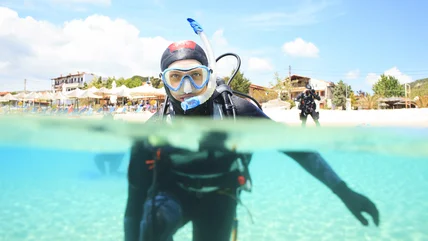
First, though, I find myself preparing to dive in the very middle of the atoll at an extraordinary geological feature surrounded by water so shallow that our captain must steer in a constant serpentine to get us there. The bottom, bright aquamarine over the flats, suddenly goes cobalt as we cross the lip of the Blue Hole. Jacques Cousteau made this site famous when he blasted a path to it for the Calypso and made a film (Secrets of the Sunken Caves, 1971) exploring its mysteries. From the air it looks like Mother Earth's blue eye, perfectly circular and unfathomable. Cousteau discovered its true depth of 430 feet, but we won't be going that far.

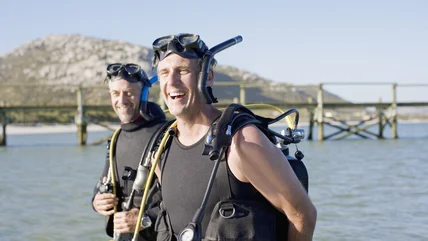
Descending along the rim, there's no sense of being in a hole. The water doesn't mix readily, and visibility is a cloudy 40 or 50 feet ¯not far enough to see the curve of the wall. Nitrogen narcosis, also known as rapture of the deep, begins to take hold of divers at 100 feet down. Every dozen feet or so below that is another toke of happy air, which can cause tunnel vision, confusion, even hallucinations. At 130 feet down, in the dim blue-gray light of depth, the wall of the vertical tunnel stops and undercuts sharply. We follow and find ourselves swimming below a curved ceiling. Researchers discovered that the Blue Hole was formerly a dry cave completely covered with a solid limestone roof. At some point ages ago, there was a collapse that created the circular skylight. Proof that the area we're swimming in was formerly bone-dry appears out of the mist in the form of a massive stalactite ¯Dripstones can form only in the air. Our small group mills around the dangling pillar for the rest of our short dive. It's an eerie sight, but lacks certain magic even with the narcosis. The stone is dead, a feature born of water drowned by the sea.

After the dive we dock at Half Moon Caye. The sky over the heavily wooded end of the island is filled with magnificent frigate birds, their 7-foot pterodactyllike wingspan lending a Jurassic-Park aura as I follow a path crawling with gigantic hermit crabs to an observation deck in the middle of seabird central.

Half Moon became Belize's first protected area in 1928 to safeguard a breeding colony of the rare white-feathered version of the red-footed booby. The colony is at least 100 years old, and every winter the females lay a single egg in nests built in the crowns of orange-flowered ziricote trees. Chicks grow fast, and the nests are filled with young, their pillowy down feathers making them as big as their parents. Boobys, though not bright enough to be scared of human hunters and thus the name, are strong flyers and excellent divers, and both parents care for the chicks, taking turns catching fish and squid. The frigates, which also nest here, are not the best of neighbors. These black-topped, hook-beaked birds can fly forever on their large wings, but can't land in water. They make their living by stealing the boobys' hard-fought catch or robbing their eggs and young. The locals call them tax collector birds.


Northern Caye is so crowded with palms that the trees at the edge of the island are forced to lean, some literally lying on the beach, to get their share of sunshine. There are new people sitting on the porch at Lighthouse Reef Resort's restaurant when we return from our day of diving. We haven't seen a plane all day, so you know there are tales to tell.

Belize has always attracted adventurers. Pat is a kayaking ex-dot-commer on a shakedown cruise before attempting an epic trip from Tobago to Florida. He bargains for a box of cereal and replenishes his water, then decides to stay for a hot meal. Our other blow-ins are off a sailboat, an Irish-English couple following Travis McGee's advice to take their retirement a bit at a time while they're still young enough to enjoy it. They plan to crisscross the Caribbean until their money runs out and they have to go back to work and save up for their next sail.


Dinner at the resort is family-style in the easy storytelling companionship of fellow divers and travelers. Afterward, I walk the beach under a sky so packed with bright stars that it's hard to find familiar constellations. Spotting a shooting star is simply a matter of watching the same arc of space for a few moments.

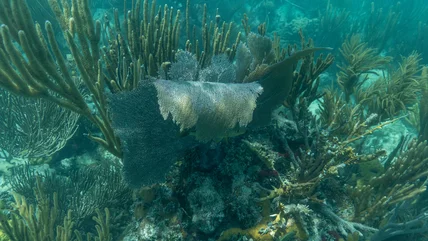
On my last dive at Lighthouse, I descend through a flowing curtain of silver jacks and head for the wall off Long Caye. An impressive formation of pillar coral stands on the reef crest. One of the few hard corals to extend the arms of its polyps during the day, pillars look exactly like stalagmites covered with a translucent fleshy fur. The reef at the top of the wall is split, and I float down into a dark crevasse. I can see the indigo of deep water that lies ahead through a short tunnel. I ease forward, and once again I'm inside a cave. Soft corals and sponges drip from the ceiling and sides like stalactites, and I barely flick my fins to avoid making contact. Here, too, as in the Cave of the Crystal Sepulchre, one touch could stop the growth of delicate structures that develop at a geological pace. I exit the cave, gliding through a coral-encrusted window thousands of feet above the seafloor. An eagle ray soaring along the wall sees my trail of bubbles and lifts a wingtip, circling close once and then wheeling off into the open ocean. Long after it has faded into the blue, I can feel its presence in the underworld of Belize.

Posted online 07/04/02.

Caribbean Map
 
What's your idea of a romantic Caribbean escape?
A secluded beach on Barbuda
A rustic eco-lodge in Belize
A glitzy resort in Providenciales
A quiet Out Island escape
A foodie retreat in St. Martin


If you like, get 8 more issues (9 in all) for the low intro price of $16.97. You save over 62% off the newsstand price. Otherwise, write "cancel" on the invoice you receive, return it, and owe nothing. The FREE issue is yours to keep!
NAME: ADDRESS:
CITY: STATE:
ZIP CODE: EMAIL: