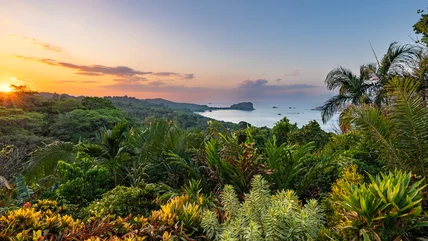
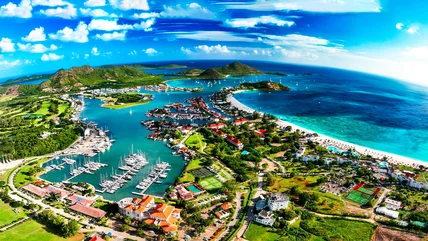
Grenada and sister islands Carriacou and Petit Martinique comprise the country of Grenada and complete the southern section of the Windward Islands. Though its mountains are dwarfed by those on islands farther north, Grenada's slopes are fertile, yielding nutmeg, cinnamon, clove and ginger mix with those of saffron, all-spice and cocoa – thus the nickname "The Isle of Spice."
To sample nutmeg, of which Grenada fills one-third of the world's needs, have a frothy rum drink at one of the bistros along L'Anse aux Epines.
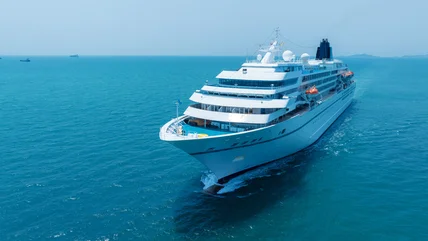
Grenada's capital, St. George's, with its tile-topped buildings, hugs a deepwater harbor in the southwest that plays host to cruise ships. Old warehouses that have been converted into quaint restaurants and small shops front the harbor area, known as the Carenage. The Sendall Tunnel, a 350-foot-long excavation that bridges the two halves of St. George's, provides access to the distinctly East Indian open-air market.
Carriacou, only 13 square miles, is home to one of the Caribbean's most famous artists, Canute Caliste. To view some of his works, stop by his studio in the town of L'Esterre. There's not much to do on Petit Martinique, except sail around it. The whole island is less than one square mile, and the biggest thing on it is the quietness.
ECO-ADVENTURE
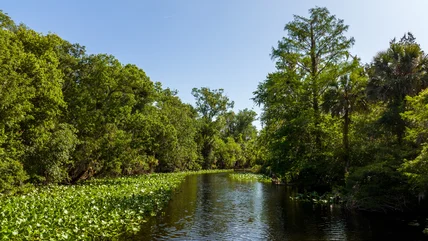
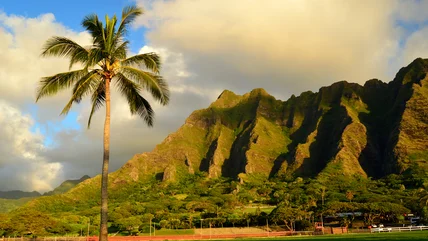
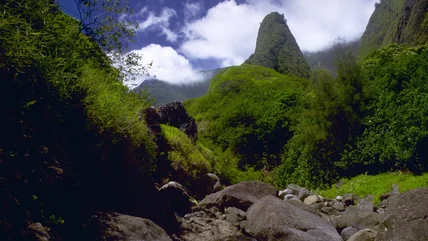
Proof of Grenada's volcanic origin is found more than 1,700 feet above sea level, where a 30-acre crater is filled with the glittering waters of the Grand Etang Lake. From here you can see the emerald-green summit of Mount Qua Qua. Mount St. Catherine is nearly 400 feet taller at 2,757 feet, but the vista-laden hiking trails of Qua Qua should not be missed.
DIVING
Another awe-inspiring sight is the Bianca C, a cruise ship that caught fire and sank in 1961. Resting upright off the southwest coast of Grenada, the enormous Bianca C. is nicknamed "the Titanic of the Caribbean."
BEACHES
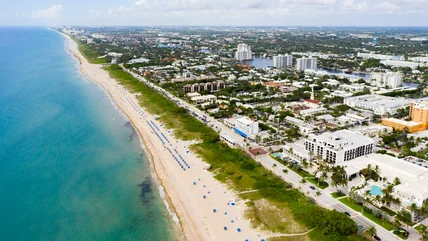
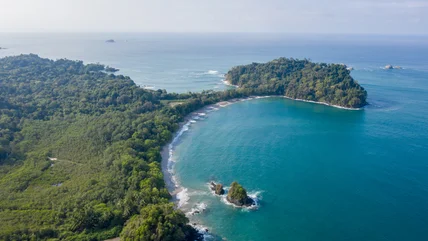
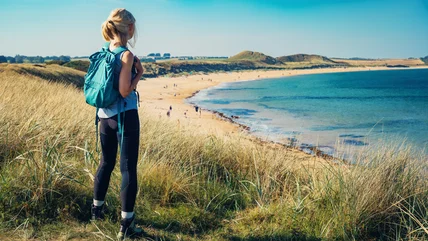
Check out the island's 40-some beaches, including Grand Anse, the islands most noted. From the tidal beaches of the north, where the Caribbean Sea and Atlantic Ocean meet in a fury, look to Petit Martinique and Carriacou just 20 miles to the north.
HISTORY
If Columbus had come ashore in 1498 when he spotted Grenada in the distance, he would have marveled at the dense rainforests kept lush by scores of waterfalls. The first European settlement, however, was not formed until 1609, when the British dared to infringe upon the island's inhabitants, the ever-ready-for-war Caribs. In 1650, the French commandeered the island. Throughout the 18th century, the island teetered between French and British control. In the end, the British won. In 1877, Grenada became a British crown colony. Three years shy of a century later, Grenada was granted independence.
In 1983, a coup led to a U.S. military intervention. Since the welcomed occupation, Grenada has enjoyed peace, prosperity and free elections.
DON'T MISS
– Sampling anything - drinks, stews and even ice cream - made with fresh nutmeg
– Showering at the base of Annandale Falls
– Hiking through Grand Etang National Park